Links with The Orkneys
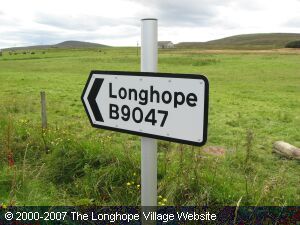 Not everyone is aware that there are, in fact, two villages called Longhope in the
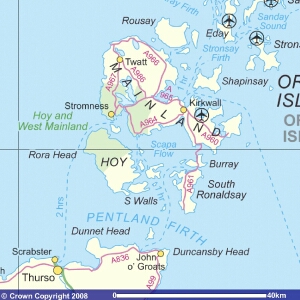
United Kingdom, one in Gloucestershire and one on Hoy in the Orkney Isles. The
Orkneys are located a few miles North of John O'Groats, at the very tip of Scotland.
Hoy is the highest (Hoy meaning high island) and second largest island in the group.
Not everyone is aware that there are, in fact, two villages called Longhope in the
United Kingdom, one in Gloucestershire and one on Hoy in the Orkney Isles. The
Orkneys are located a few miles North of John O'Groats, at the very tip of Scotland.
Hoy is the highest (Hoy meaning high island) and second largest island in the group.
Longhope Lifeboat
A lifeboat has existed on the Island of Hoy since 1874, with the old lifeboat station now housing the Longhope Lifeboat Museum. Our two communities have always had links but this was reinforced when, in 1969, the lifeboat named TGB (after an unknown benefactor) capsized with the loss of the entire crew while assisting a Liberian cargo ship by the name of "Irene".
The Longhope lifeboat was launched under the experienced control of coxswain, Dan Kirkpatrick, from the small village of Brims, Longhope, at 8pm on 17th March after a Mayday call by the captain of the 2,300 ton Liberian cargo steamer, "Irene" which was drifting out of control in a force nine, south-easterly gale. The captain of the "Irene" gave her position as 18 miles off South Ronaldsay, but she was actually only three miles off the east coast. The Coastguard had been alerted to carry out a breeches buoy rescue from the clifftop, if the opportunity presented itself.
At the same time as the TGB was launched, the Kirkwall lifeboat, the "Grace Paterson Ritchie", put to sea. At 8.40pm the TGB gave her position as 3 miles south-east of Cantick Head Lighthouse on South Walls, five miles from home, and entering the dangerous tidal race with speeds of nine knots on the spring flood tide. High tide at the nearby Pentland Skerries was just after midnight, so the flood was now near its full strength. At 9.30 pm, the TGB was sighted by the Principal Lightkeepers in the new position at Pentland Skerries in line with Lother Rock, about four miles south-east of her last reported position. The TGB was now in an almost deadly situation, with the flood running like a millrace to the south-east out of the Firth and meeting the flood pouring down the east side of South Ronaldsay. The last reported signal for the TGB was picked up by the Coastguard headquarters at Wick, at 9.35pm, and a few minutes later she was seen for the last time, again from Pentland Skerries, in Brough Sound, between the Lighthouse and Brough Ness.
It proved impossible even for the larger 70ft Kirkwall lifeboat "Grace Paterson Ritchie" to approach the stricken "Irene". At 11.05pm, Kirkwall Coastguard Headquarters asked her coxswain to search the coast of South Ronaldsay south-wards for the TGB. At 11.15pm the Kirkwall boat fired a parachute flare, but there was no answering signal. Nothing more was seen of the Longhope lifeboat until at 1.15pm the following afternoon, when the Thurso lifeboat made the tragic discovery of her floating upside down, four miles south-west of Torness, fifteen miles away at the western entrance to the Pentland Firth.
![[The TGB]](images/103_1.jpg)
|
| The ill-fated lifeboat, "TGB" now preserved at the Scottish Maritime Museum at Irvine.
With thanks to www.undiscoveredscotland.co.uk for the use of their photograph. |
When the TGB was righted in Scrabster Harbour she was found to have suffered serious hull damage. Seven bodies were found on board, six in the cabin, the seventh, that of the coxswain, at the wheel with a broken neck. The eighth member of the crew, the motor mechanic, was never found. The findings of the RNLI inquiry were that the TGB had been overwhelmed by very high seas and maelstrom conditions while proceeding eastwards between South Ronaldsay and the Pentland Skerries. Ironically, the 17 crew of the "Irene" were rescued from the shore, where she had drifted, near Grim Ness, at the north-eastern end of South Ronaldsay, by the two coastguard emergency companies, in the biggest breeches buoy operation to have ever taken place in Orkney. The Orkney MP at the time, Jo Grimmond, called for a full inquiry which was tardy in coming, but the only report was issued by the Liberian government. It hinted that the 22 year-old ship had ran out of fuel only two days after leaving Granton for Norway. It also stated that the ship's officers had no idea where they were, and that the captain thought that they were off the coast of Norway, when in fact they were 300 miles away! Mysteriously too, none of the ship's papers and logs were ever recovered, making it very difficult to assess the captain's actions!
At the time the Longhope boat was lost, it would seem very likely that no boat could have survived in the conditions prevailing north of the Pentland Skerries at that time, with an immense wind against an even more immense tide which would produce seas up to 60ft high with correspondingly deep pits between them. It was believed that the TGB was turned end over end and then fell from a great height, either stunning the crew or creating such disarray that it would be beyond human capacity to handle the boat. This was the worst lifeboat disaster to ever strike the Orkneys, and indeed the whole of Britain. All eight crewmen lost their lives – and included two fathers both with two sons on board – and leaving behind seven widows and ten fatherless children; all of them were from the tiny village of Brims with a total population of 30. Almost a quarter of them, the most experienced in the ways of the sea, had been taken away in one bitter blow. “The Orcadian” (Orkney’s newspaper) commented: “All Orkney this week mourns over the tragic loss of the Longhope lifeboat with its crew of eight fine men. Right up until the last minute, everyone was hoping against hope that the lifeboat crew who had so often snatched others from what looked like certain death might still themselves have a chance. Then came the sad, final messages. There was no hope. The crew of the Longhope lifeboat were dead.”
Those that died were, as previously mentioned, Dan Kirkpatrick who was 59, the coxswain, together with two of his sons, Ray who was 29 and the bowman, and Jack, 26 a crewman. Both were married with a child. The engineer Robert R. Johnston, who was 61, and his two sons, James, the second coxswain at 34 and Robbie, a crewman at 31. Both sons were married and both had two children. Also to die was the assistant mechanic, Jim Swanson who left a wife. A single man of 24, Eric McFadyen, volunteered to go at the last minute, but didn't have to, as the lifeboat could have sailed with seven crewmen.
The RNLI decided that the TGB would be repaired in the south of England and returned to service - but nowhere near the north of Scotland of course. The chairman of the RNLI, Admiral Sir Wilfrid Woods, announced that eight men had already come forward from Longhope to volunteer to crew a new lifeboat on station at Longhope as soon as possible. Five of them were close relatives to some of the men that died. It was said that all the people of Longhope, including the widows of the men that died, definitely did not like the idea of no lifeboat being there when fishermen and other people may be in danger and in need of rescue. "An empty lifeboat shed is a very sad reminder." Their wish was granted in the summer of 1970 with the arrival of the temporary lifeboat, "Hilton Briggs."
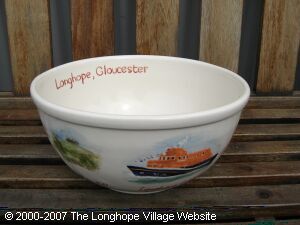 The museum (official website) has many artifacts including this
bowl that was presented by George and Eileen Watkins in August 2004. It has a series of
pictures on the side including All Saints' Church, May Hill, The Old Man of Hoy, The
Lifeboat Museum Building and the Longhope Lifeboat.
The museum (official website) has many artifacts including this
bowl that was presented by George and Eileen Watkins in August 2004. It has a series of
pictures on the side including All Saints' Church, May Hill, The Old Man of Hoy, The
Lifeboat Museum Building and the Longhope Lifeboat.
North Walls Community School