Industry
The Furnace
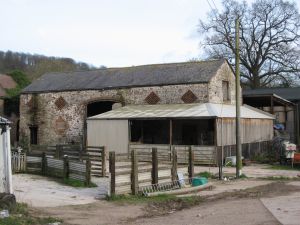
Thomas Foley (b. 1616) married Anne, daughter of John Browne, the iron founder at the time. He made an agreement on 15th. February, 1656 with Thomas Nourse of Longhope, the same year in which a furnace called Hope was built, believed to be near the current Court Farm, that stated much of the iron was to be carried to Longhope from other parts of the Forest of Dean for smelting. It was leased for the next 21 years for £100 per annum. The furnace was still standing in 1680, albiet disused.
In 1672, Paul Foley of Stoke Edith, Herefordshire purchased the "whole of the materials of the king's works" in the Forest of Dean. He leased the furnace at Longhope from the lord of the manor at the time, Nourse Yate on 27th. June, 1682 for 15 years at £60 per annum. The furnace appears to have been quite substantial and it is mentioned in 1682 when Thomas Baskerville saw it on his way from Ross to Gloucester.
The furnace appears to have no later history than 1717, as a map of the estate in this year marks a site where the furnace formerly stood. More recently, archaeological surveys have uncovered iron slag and charcoal around the area to the North of the church and Court Farm [2].
The Tannery
A tannery stood south of the village where Frederick Coleman was known to be the tanner there between the years 1851-1858 and is now known as Furnace Mill, along Mill Lane. This was also used originally as a furnace.
Hobbs Quarry
Hobbs Quarry is a rare exposure of fossilised reefs that were formed over 400 million years ago. Hobbs Quarry is one of Longhope's Special Sites of Scientific Interest (SSSI). The rocks from the quarry were used in the creation of iron. A process known as smelting was used which initially involved melting the iron ore with charcoal. Without getting too scientific, this turns the iron ore into iron. At this stage there are still lots of other materials present in the iron known as impurities. These impurities can be removed with the addition of limestone. In about 1670, Longhope used about two and a half tonnes of coal.
The Read's
Various members of the Read family have operated in the road haulage industry for more than 80 years. The brothers Richard, Harold, and George have all been involved. George Read was taken over by British Road Services, once when the nationalisation programme for the haulage industry was in force in 1949, and again in 1965, when the family decided to sell the business on the death of Mr Read. George Read persuaded his younger brother Harold to start his own haulage business, and transferred one of his lorries from his to Harold's name. George Read's son (George M Read) now has his own business at The Wilderness Quarry, Mitcheldean, while Richard Read is on the Monmouth Road at Longhope, and Harold Read operates from Church Road, Longhope.
Jam Making
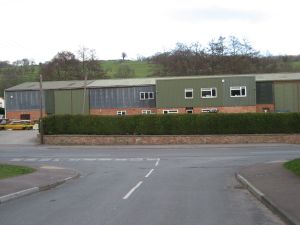
Sadly, jam is no longer made in Longhope but to this day the welding workshop is referred to as the "Jam Factory".
James Constance & Sons
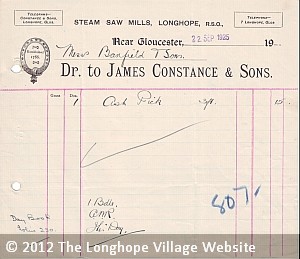
It has been in the Allan family since around 1935 and it is still a going concern today, as a woodland owner, it is involved in coppicing and the provider of logs for local household use. The old buildings of the original sawmill form an industrial estate which are let out as business units.
Bonnie's Café
Bonnie's Café was owned by a lady called Bonnie, who made all of her own cakes, that was situated in the house adjacent to the current post office. The front room of the house was the actual café, a doctor's surgery in the bedroom above and a coffin maker in the back room, which used to be the post office. It was possible, therefore, to have a cup of tea, go and see the doctor and if there was no hope you could go and have your coffin made.
In December 2006, "Café Bonnies" started up again in the village, held at the Latchen Rooms on the second Saturday of every month commencing at 10:00am.
References
- John Meredith, "The Iron Industry of the Forest of Dean", Tempus, 2006.
- J. Jurica, "Transactions of the Bristol and Gloucester Arcaeological Society", v. 119, 2001.