All Saints' Church
In The Beginning
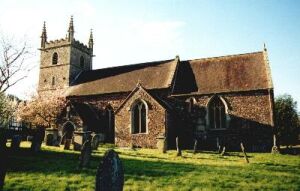
At the time of the Domesday Book, many people overlook the fact that Longhope was in the diocese of Hereford, not Gloucester. It only became part of Gloucester in 1542.
The first firm evidence we have for the existance of the church is recorded in the Acta of the bishop of Hereford when, in 1144, Longhope Church, along with other churches in the area, is mentioned in the Acta of the Bishop of Hereford as having been granted to the priory of St. Mary and St. Florence, Monmouth by Baderon [3] the third lord of Monmouth and grandson of William fitz Baderon. This was usually to increase the wealth of the priory as it could claim a proportion of the tithes from Longhope. Many parishioners at the time took this to mean that they were providing goods to a higher spiritual authority [1] . The priory was established in 1075 by the brother of William, Withenock [4] , but the reader should consult other sources for a more comprehensive history of the priory. The name Baderon is probably the anglicised form of the Norman name Baladon.
The church is situated not far from Hope Brook which was a common requirement for mediaeval churches as they needed water for the font [1] . In its day, All Saints would have been roughly in the centre of the parish of Longhope.
Rubble, Stones and Mortar
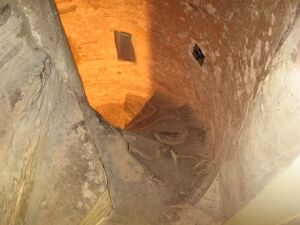
It is thought that the church underwent some development during the 13th century, a period when most churches were extended. The size of the chancel was increased and the north and south transepts were added [2] . Interestingly, the walls of the north transept are much thicker than the south for reasons we don't know.
Later, in the 14th century, the porch and several of the windows, including one in the north transept were added.
The chancel was rebuilt in the 17th century.
Throughout the 19th century it is clear that both the church and tower were in a bad state of repair and required "much needed expenditure", as recorded by the vestry minutes. In 1808 the spire was in a dangerous state that it required repairing. This work was carried out by Richard Goodman. Later, in 1869, the records show that the tower was in danger of falling down as the tower and parts of the nave were beginning to buckle, as they couldn't support the weight of the spire. The architect A. W. Maberly produced plans to remove the spire completely and the top part of the tower down to the top of the first window and then rebuild the tower to how it looks today. The circular windows were intended to display a clock, which has never appeared. Maberly estimated the cost to be around £400, even more if the spire was to be rebuilt and so just the tower was rebuilt as not enough money could be found to fund a new spire. It is not known when the spire was first built, although Bigland recorded "...and a Steeple at the West End" [5] . This shows that the church had a spire in about 1778. A picture of the church with spire can be found in the Then and Now section. The work was carried out by Edwin Organ who also added external buttresses to help support the tower and the north vestries. It can be seen that the vestries were constructed at a different time to the rest of the church as the stones used are different. It is recorded that these stones came from George Dawe's quarry, but it is not known where abouts the quarry was actually located.
Later, in 1888, a total of £11 17s. 7d. was spent hiring F. Field, a local mason, to construct a substantial buttress to support the north wall and pointing other parts of the church. Barely a year later, in September 1889, a grand sum of £32 13s. 6d. was spent on the "Varnishing of the whole Church Ceiling, Roof [and] Pews" and a slightly lesser sum of £25 14s. is recorded as having been spent for work done on the chancel by G. Corke of Newnham. Perhaps the parish's biggest expense of the time was in 1891 when the tower had to be repaired. The total cost of the tower amounted to £44 8s. 2d. of which £6 15s. was paid to Messrs. Waller, the architect. The churchwardens at the time, William Constance and R. S. Kearsey, gained £4 towards the cost of the tower from the sale of old materials from the original tower. A breakdown of expenditure and income can be found here.
Bells
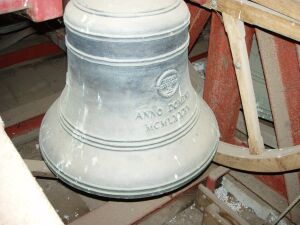
- A treble weighing 5cwt. tuned to E.
- Bell number two weighing 6cwt. tuned to D.
- Bell number three weighing 6cwt. tuned to C.
- Bell number four weighing 7cwt. tuned to B.
- A tenor weighing 10cwt. tuned to A.
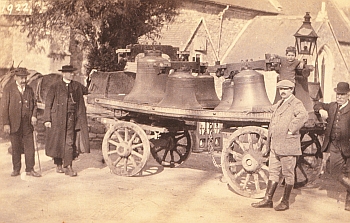
"There was a large congregation at the dedication service on Wednesday evening and in the brilliant evening sunshine the well-kept interior looked pretty with its Easter floral decorations of daffodils, which grow wild in profusion almost up to the Churchyard boundary...
The Font
The font of All Saints deserves a special mention because it has suffered much over the years. The original was destroyed during the civil war when the Long Parliament demanded that all fonts be destroyed in 1645. Following the Restoration of 1660, a substitute font had to be found. A domestic mortar was donated to the church to fulfill this role [5] and remained there until 1860 when the present font was built. That was not the end of the mortar, though. It was stored at Court Farm (behind the church) until the death of the churchwarden, when it was sold to a farmer at Southside, May Hill [5] . He used the mortar for many years as a pig trough, which was broken on one side to allow a piglet to be able to feed. The farmer eventually returned the mortar to the church where it rested on top of an old saxon cross socket and some pilasters [5] . Sadly, the mortar was stolen in the 1980s
Restoration Works
From 2010 to 2012 the church was given a new roof and, during some refurbishments in the chancel, part of the original floor was uncovered revealing a number of flat stones bearing inscriptions. These were first recorded by Bigland in about 1778 when he visited Longhope. Previously, it was thought that the stones had been tiled over by the current chancel floor during the Victorian era but appears that many, if not all, could still be in-tact beneath the current floor. To read more details about these recent works click here.
Endowment and Value
Pope Nicholas' taxiation of 1291, commonly refered to as Taxatio, reveals that the church of Longhope had a value of £3 6s 8d and decima (Latin for "a tenth part tithe") of 6s 8d. The Taxatio also mentions that Longhope was still owned by "Prioris Monemute [Monmouth Priory]" [8] .
By 1675 the impropriation belonged to Thomas Nourse esq. [7] .
By 1742, when the vicar was Yate Bromwich senior, the Impropriation was re-granted by the Priory of St. Mary and St. Florence in Monmouth [7] [9] .
Miscellaneous Statistics, Notes and Lists
Longhope's oldest man died in 1708 at an age of somewhere between 124 and 135. His original headstone no-longer exists in the churchyard but the existence of it was recorded by Ralpha Bigland and Thomas Rudder in about 1778 and again by an unknown newspaper article in 1921. The inscription reads
of
Thomas Bright,
who departed this life
October 28th, Ano. 1708,
aged 124 years
His patience was by long affliction tryd
In stedfast Faith and Hope he lived and dyed.
The burial register for All Saints' notes that he was "around at the time of Elizabeth I, buried between 14-15 October." Queen Elizabeth I reigned from 1558 until her death in 1603.
Gravestone Inscriptions for all readable gravestones in the churchyard.
Annual Births, Marriages and Burials for the years 1600-1835.
Patrons and Incumbents for the years 1318-2005.
Architecture of All Saints'.
References
- Pounds, N. J. G., "A History of the English Parish", Cambridge University Press.
- Mike Salter, "Parish Churches of the Forest of Dean", Folly Publications, 2001.
- Julia Barrow, "English Episcopal Acta VII Hereford 1079-1234", Oxford University Press, 1993.
- J. Bradney, "A History of Monmouthshire. Part 1: The Hundred of Skenfrith", Mitchel Hughes and Clarke, London, 1904.
- Austin, R., "Transactions of the Bristol and Gloucester Archaeological Society (1927)", TBGAS, 46(1927):146-
- Private documents
- B. Firth, "Bigland's Gloucestershire Collections (D-M)", TBGAS, GRS
- S. Ayscough and J. Caley, "Taxatio Ecclesiastica Angliae et Walliae, Auctoritate P. Nicholai IV, circa 1291", Record Commissioners, London, 1802.
- J. Fendly, "Bishop Benson's Survey of the Diocese of Gloucester, 1735-50", TBGAS, GRS 13.